
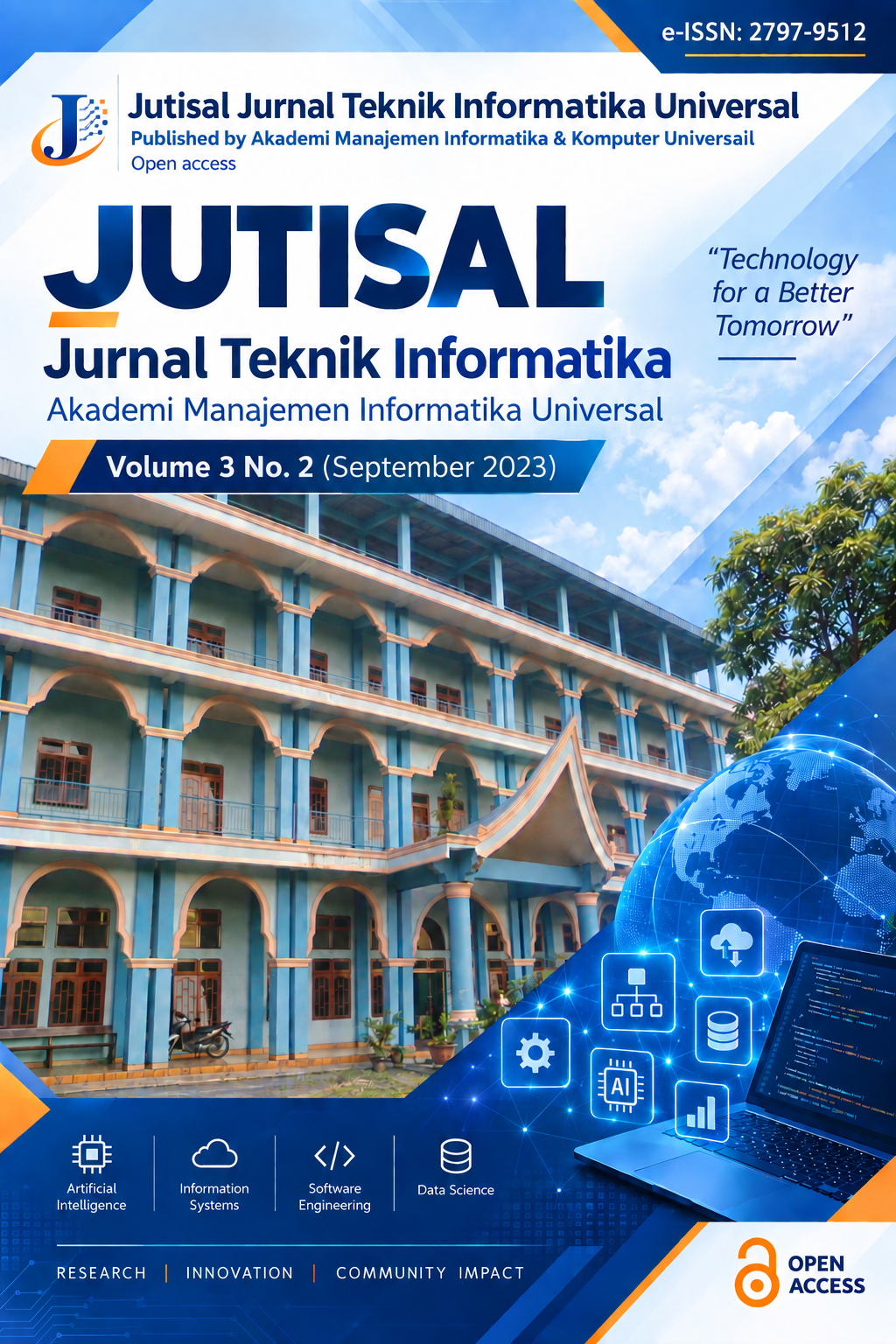
Vol. 3 No. 2 (2023): Jutisal Jurnal Teknik Informatika Universal
Articles
-
Rancang Bangun Sistem Informasi Manajemen Aset Berbasis Web Menggunakan QR Code Untuk Meningkatkan Efisiensi Inventarisasi AMIK Universal
Aprima Matondang Program Studi Teknik Informatika, Akademi Manajemen Informatika Komputer Universal Indonesia , Dea Nita Deslia Sari Program Studi Manajemen Informatika, Akademi Manajemen Informatika Komputer Universal Indonesia , Muhammad Eka Zuwanda Program Studi Manajemen Informatika, Akademi Manajemen Informatika Komputer Universal Indonesia , Harsinah Yohanni Tumanggor Program Studi Manajemen Informatika, Akademi Manajemen Informatika Komputer Universal Indonesia , Nova Legahati Siregar Program Studi Manajemen Sumber Daya Manusia Sektor Publik, Akademi Manajemen Informatika Komputer Universal, Medan, Indonesia Indonesia , Retno Nela Simanjuntak Program Studi Akuntansi Perpajakan, Akademi Manajemen Informatika Komputer Universal, Medan, Indonesia IndonesiaAsset management is an important activity in supporting the operational activities of higher education institutions. Assets such as computers, laptops, network equipment, laboratory equipment, furniture, and other facilities need to be systematically recorded and monitored to ensure accurate information regarding their existence, location, condition, and utilization. Conventional asset inventory management using documents or spreadsheets may result in duplicate records, difficulties in tracking asset locations, delays in updating information, and discrepancies between administrative records and physical asset conditions. This study aims to design and develop a web-based asset management information system integrated with Quick Response (QR) Code technology as a digital identity for higher education assets. The research employs a Research and Development (R&D) approach using the Waterfall software development model, consisting of requirements analysis, system design, implementation, testing, and maintenance. The proposed system provides several features, including asset data management, asset categorization, location management, QR Code generation, asset identification through QR Code scanning, asset mutation recording, asset history management, and inventory reporting. The system is designed using Unified Modeling Language (UML), while functional validation is conducted using Black Box Testing. The integration of QR Code enables physical assets to be linked with their corresponding digital information, allowing users to identify and access asset information more efficiently through web-based devices. The proposed system is expected to support higher education institutions in improving asset traceability, facilitating inventory activities, reducing manual data processing, and providing integrated asset information for management and reporting purposes.
Pages: 1-11Views: 55 Downloads: 0Analisis Efektivitas Penggunaan AI Generatif (ChatGPT) Dalam Pengembangan Perangkat Lunak: Sistem Komparasi Produktivitas Developer Mahasiswa Manajemen Informatika
Lusi Victoria Lumbangaol Program Studi Manajemen Informatika Informatika, Akademi Manajemen Informatika Komputer Universal Indonesia , Imam Setiawan Program Studi Manajemen Informatika Informatika, Akademi Manajemen Informatika Komputer Universal Indonesia , Fatimah Zuhra Hasibuan Program Studi Manajemen Informatika Informatika, Akademi Manajemen Informatika Komputer Universal Indonesia , Juanto Simangunsong Program Studi Teknik Informatika, Akademi Manajemen Informatika Komputer Universal Indonesia , Fachrun Nissa Program Studi Akuntansi Perpajakan, Akademi Manajemen Informatika Komputer Universal Indonesia , Muhammad Harpis Program Studi Manajemen Sumber Daya Manusia Sektor Publik, Akademi Manajemen Informatika Komputer Universal IndonesiaThe rapid adoption of Generative AI, particularly ChatGPT, has transformed software development practices globally. While prior studies have examined ChatGPT’s technical capabilities in code generation and debugging, there remains limited empirical understanding of how different user groups—novice developers and management informatics students—actually leverage this tool in real-world software development tasks. This study aims to analyze the effectiveness of ChatGPT usage in software development processes by comparing the productivity of novice developers and management informatics students. A quantitative experimental approach with a comparative design was employed, involving 40 participants divided into two groups: 20 novice developers and 20 management informatics students. Each participant completed identical software development tasks (debugging, code generation, and code explanation) under two conditions: with ChatGPT assistance and without ChatGPT assistance. Data were collected through task completion time, accuracy scores, and a Likert-scale questionnaire. The results show that ChatGPT usage significantly improves productivity for both groups, with an average time reduction of 42% for novice developers and 38% for management informatics students. However, a quality paradox was identified: while speed increased, participants required substantial verification efforts to ensure code correctness. The study concludes that ChatGPT is an effective productivity tool for software development, but its integration requires careful consideration of verification practices and critical thinking skills.
Pages: 12-20Views: 23 Downloads: 18
Additional Menu
Manuscript Template
Information
About Journal
Jutisal Jurnal Teknik Informatika Universal is a peer-reviewed academic journal that publishes scientific research and scholarly works in the field of Informatics and Computer Science.
e-ISSN: 2797-9512
Contact
AMIK Universal
Jl. Setia Budi No. 20 A-D, Simpang Pemda, Tanjung Sari, Medan, Provinsi Sumatera Utara.
Email: admin@jurnal.universal.ac.id
WA/Telp: +62 813-7642-7511